
I spent the better part of last year helping a mid-sized insurance company overhaul their customer service operations. Their wait times had ballooned to an average of 23 minutes. Customer satisfaction scores were tanking. Agent turnover was approaching 40% annually because their team was drowning in repetitive inquiries while genuinely complex cases got lost in the shuffle.
Eight months after implementing NLP-powered solutions, their average response time dropped to under four minutes. Satisfaction scores jumped by 31 points. And perhaps most surprisingly, their human agents reported higher job satisfaction because they were finally doing meaningful work instead of answering the same billing questions hundreds of times daily.
That experience crystallized something I’d been observing across industries: natural language processing isn’t just another tech buzzword. When implemented thoughtfully, it fundamentally changes what’s possible in customer service.
Understanding NLP in the Customer Service Context
Natural language processing sits at the intersection of linguistics, computer science, and customer psychology. At its core, NLP enables machines to interpret, analyze, and respond to human language in ways that feel natural rather than robotic.
This matters enormously for customer service because human communication is messy. Customers don’t submit perfectly formatted tickets with clear categorization. They send frustrated emails riddled with typos at 2 AM. They call hotlines while driving, talking over background noise, switching topics mid-sentence. They message through chat windows using slang, abbreviations, and emoji.
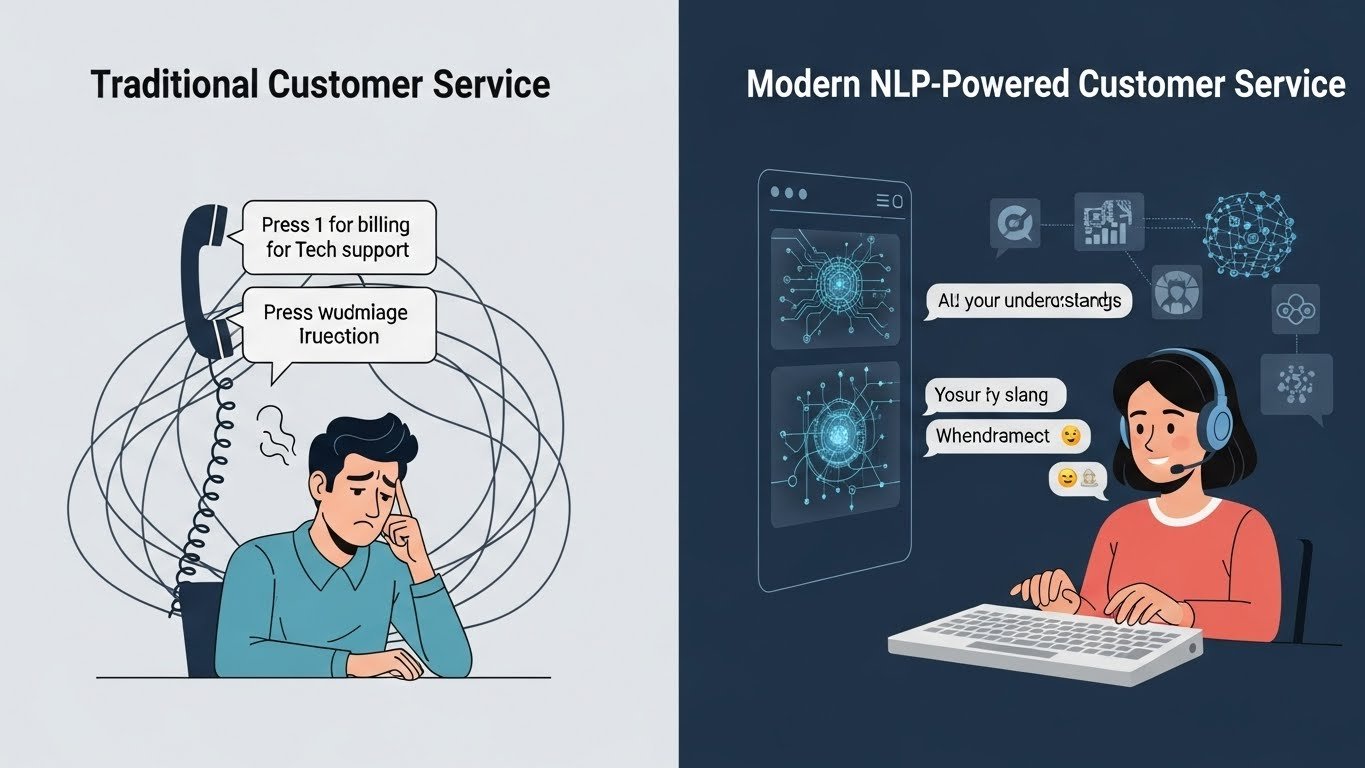
Traditional automated systems failed spectacularly at handling this complexity. Press 1 for billing, press 2 for technical support—we all remember the frustration of those rigid phone trees that never seemed to have an option matching our actual problem.
Modern NLP changes the equation entirely. Instead of forcing customers to conform to rigid system requirements, the technology adapts to how people actually communicate.
Where NLP Makes the Biggest Impact
Intelligent Conversation Systems
The most visible application is in conversational systems—what most people know as chatbots, though that term doesn’t capture how sophisticated these have become.
I’ve watched this technology evolve dramatically. Early chatbots were essentially glorified FAQ searches. They could match keywords to pre-written responses, but any deviation from expected phrasing caused immediate failure. Ask “what are your hours?” and you’d get an answer. Ask “when can I visit?” and the system would likely respond with confusion.
Contemporary NLP-powered systems understand intent rather than just matching words. They recognize that “I can’t log in,” “my password isn’t working,” “the system won’t accept my credentials,” and “help I’m locked out of my account” all describe the same fundamental problem.
More importantly, these systems maintain context across conversations. A customer can say “I ordered the blue one, not the green one” and the system understands this refers to a previously discussed order without requiring repeated explanation.
A telecommunications client I worked with deployed an NLP conversation system that now handles 67% of initial customer inquiries without human intervention. But here’s the critical detail: customers can escalate to human agents whenever the conversation becomes too complex, and the full context transfers seamlessly. The human agent sees everything that was discussed, picks up where the system left off, and the customer never has to repeat themselves.
Sentiment Analysis and Emotional Intelligence
This application doesn’t get enough attention, but it’s transforming how companies manage customer relationships.
NLP can analyze the emotional content of customer communications in real-time. Not just whether someone is happy or upset, but detecting nuances like frustration building over multiple interactions, genuine anger versus mild annoyance, or relief when a problem gets resolved.
One e-commerce company I consulted with uses sentiment analysis across all customer touchpoints. When their system detects a pattern of increasing frustration—maybe a customer has contacted support three times about the same issue, with each message showing elevated negative sentiment—it automatically escalates that case and flags it for priority handling.
The results were striking. Customers identified as at-risk of churn received proactive outreach, often with special resolution efforts. Their save rate for potentially lost customers improved by 44%.
But sentiment analysis also works internally. Supervisors can monitor overall team interactions to identify agents who might be struggling, spot training opportunities, or recognize patterns suggesting burnout before it leads to turnover.
Intelligent Routing and Prioritization
Not all customer inquiries are equal. A confused first-time buyer asking about product specifications is fundamentally different from a longtime customer threatening to cancel their subscription. Yet traditional queue systems treated them identically.
NLP enables sophisticated routing based on content analysis. Messages mentioning keywords like “cancel,” “competitor,” or “final attempt” can be prioritized and directed to retention specialists. Technical inquiries get routed to agents with relevant expertise. Simple questions go to automated resolution while complex issues reach human specialists immediately.
A banking client reduced their average resolution time by 38% simply by implementing better routing. Previously, inquiries landed in a general queue and were assigned round-robin style. With NLP-powered routing, each inquiry reaches the appropriate resource the first time, eliminating the internal transfers that waste everyone’s time.
Voice Analysis and Phone Support
Written communication is just one channel. NLP has made similar advances in processing spoken language, enabling sophisticated voice-based customer service.
Real-time transcription allows agents to reference what was said earlier in long calls. Automated systems can understand natural speech rather than requiring customers to speak in stilted, keyword-heavy phrases. Post-call analysis can identify coaching opportunities, compliance issues, or emerging trends across thousands of conversations.
I’ve seen contact centers use voice analysis to detect when customers are becoming agitated—subtle changes in speech patterns, tone, and word choice—and prompt agents with de-escalation techniques or supervisor involvement before situations deteriorate.
Multilingual Support at Scale
Here’s something that particularly excites me: NLP is democratizing multilingual customer service in ways that weren’t economically feasible before.
Previously, offering native-language support meant staffing agents fluent in each language you wanted to cover. For global companies, this meant either massive investment or accepting that customers in smaller markets would receive inferior service.
Modern NLP enables real-time translation that maintains conversational nuance. A Spanish-speaking customer and an English-speaking agent can communicate naturally, with the system handling translation transparently. The technology isn’t perfect—idioms and cultural nuances sometimes get lost—but it’s remarkably effective for typical service interactions.
A software company I advised expanded from English-only support to covering twelve languages without hiring a single new agent. Their international customer satisfaction scores improved dramatically simply because customers could communicate in their preferred language.
The Real-World Benefits
For Customers
The most significant benefit is availability. NLP-powered systems don’t sleep, don’t take breaks, and don’t have bad days. A customer with an urgent question at 3 AM gets immediate assistance rather than waiting until business hours.
Speed matters too. When simple inquiries are resolved instantly through automated systems, customers with complex issues don’t have to wait behind dozens of simple questions. The overall experience improves for everyone.
There’s also something to be said for consistency. Human agents vary in knowledge, mood, and approach. Well-implemented NLP systems deliver consistent, accurate responses every time. That billing policy question gets the same correct answer whether it’s asked on Monday morning or Saturday night.
For Businesses
The economic case is compelling but nuanced. Yes, NLP can handle inquiries that would otherwise require human agents, reducing staffing costs. But the better framing is efficiency rather than replacement.
Consider this: a typical customer service agent might handle 50-70 interactions daily. Much of that volume consists of repetitive, simple inquiries that don’t require human judgment. When automated systems handle that volume, the same number of agents can focus on complex issues requiring empathy, creativity, or specialized knowledge.
The data generated by NLP systems also has tremendous value. Analyzing thousands of customer interactions reveals patterns invisible to human observation. What features confuse customers? What policies generate the most complaints? What language resonates when explaining complex concepts? These insights inform product development, documentation, training, and strategic decisions.
For Service Teams
I’ve seen skepticism from customer service professionals who worry about job displacement. In my experience, the reality is more positive than feared.
Agents freed from repetitive inquiries report higher job satisfaction. They’re solving real problems, using judgment and creativity, building relationships with customers facing genuine challenges. The boring parts of the job get automated while the rewarding parts remain human.
The technology also provides support during interactions. Real-time suggestions, relevant knowledge base articles surfaced automatically, and context from previous interactions—these tools help agents perform better rather than replacing them.
Implementation Realities and Challenges
Anyone who’s actually deployed these systems knows that the technology is only part of the equation. Getting NLP to work effectively in customer service contexts requires significant effort.
Training Data and Customization
Out-of-the-box NLP solutions rarely work well for specialized businesses. The language customers use in healthcare differs from retail, which differs from financial services. Industry-specific terminology, common customer questions, and expected response formats all require customization.
The insurance company I mentioned earlier spent three months training their system on historical customer interactions before going live. They discovered that customers used informal terms for insurance concepts that the generic system couldn’t understand. “Deductible” became “the amount I pay first.” Policy numbers were referred to as “my account number.” Without this customization, the system would have failed constantly.
Integration Complexity
NLP systems need access to customer data, order history, account status, and other systems to provide useful responses. Integration with legacy technology—often decades old in established companies—presents real challenges.
I’ve seen implementations stall for months while teams worked through API connections, data formatting issues, and security requirements. Planning for integration complexity upfront prevents frustrating delays.
Managing Expectations
Perhaps the biggest challenge is expectation management. Executives sometimes expect NLP to magically solve all customer service problems immediately. The technology is impressive, but it has limitations.
NLP systems can misunderstand unusual phrasing, miss sarcasm or irony, and struggle with highly technical or specialized topics. They need ongoing monitoring, refinement, and human oversight. Presenting realistic expectations upfront—including specific use cases where the technology excels and situations where human agents remain essential—leads to better outcomes than overpromising.
Continuous Improvement
Unlike installing a piece of equipment and walking away, NLP implementations require ongoing attention. Language evolves. Customer needs change. New products or policies require system updates.
The most successful implementations I’ve seen treat NLP as a living system requiring regular review. They analyze failed interactions, identify patterns, and continuously improve the system’s capabilities.
The Human Element Remains Essential
I want to be clear about something: NLP enhances human customer service; it doesn’t replace it. The companies achieving the best results are those that thoughtfully combine automated capabilities with human expertise.
Complex problems still need human judgment. Emotionally charged situations require genuine empathy. Unusual circumstances that fall outside anticipated scenarios need creative problem-solving. And many customers simply prefer interacting with humans, particularly for sensitive matters.
The key is designing systems where the handoff between automated and human service feels seamless rather than jarring. When a customer reaches a point where human assistance is needed, that transition should happen smoothly, with full context transferred, so the customer doesn’t feel bounced around or ignored.
One retail client created what they call “warm transfers”—when their NLP system determines a human agent is needed, it provides a brief summary explaining why the transfer is happening and what’s already been discussed. Customers feel heard rather than dismissed, and agents have the context needed to help immediately.
Ethical Considerations That Matter
Deploying NLP in customer service raises important ethical questions that responsible organizations need to address.
Transparency
Should customers know when they’re interacting with an automated system versus a human? My strong opinion is yes. Pretending a bot is human damages trust when customers discover the deception—and they usually do. Companies that are upfront about their automated systems often find customers accept them readily, especially when the systems work well.
Privacy and Data Usage
NLP systems learn from customer interactions, raising questions about consent and data usage. Who owns the transcripts of customer conversations? How long are they retained? Can they be used for purposes beyond the immediate service interaction?
Clear policies, transparent communication, and robust data protection aren’t just legally required in many jurisdictions—they’re essential for maintaining customer trust.
Bias and Fairness
NLP systems can perpetuate or amplify biases present in their training data. If historical customer service interactions showed different treatment based on customer demographics, those patterns could be learned and replicated.
Regular auditing for bias, diverse training data, and human oversight help mitigate these risks, but they require ongoing attention rather than one-time review.
Accessibility
Automated systems must remain accessible to customers with disabilities. Voice-based systems need alternatives for hearing-impaired customers. Text-based systems should work with screen readers. Designing for accessibility from the start is far easier than retrofitting later.
Looking Ahead
The trajectory of NLP in customer service points toward increasingly sophisticated and natural interactions. Several trends seem particularly significant.
Personalization will deepen. Rather than treating all customers identically, systems will adapt communication style, proactive outreach, and solution offerings based on individual customer history, preferences, and behavior patterns.
Proactive service will expand. Instead of waiting for customers to report problems, NLP analysis of product usage, payment patterns, and other signals will enable companies to identify and address issues before customers are even aware of them.
Omnichannel coherence will improve. Whether a customer starts on chat, moves to email, and finishes with a phone call, the entire conversation history and context will flow seamlessly across channels.
Voice interaction will become more natural. As speech recognition and synthesis improve, voice-based customer service will feel increasingly like talking with a knowledgeable human rather than speaking at a machine.
Practical Recommendations for Implementation
For organizations considering NLP-powered customer service, a few principles guide successful implementations:
Start with clear objectives. What specific problems are you trying to solve? Reduce wait times? Handle after-hours inquiries? Improve routing efficiency? Specific goals enable meaningful measurement and prevent scope creep.
Begin with high-volume, low-complexity use cases. Password resets, order status inquiries, basic product questions—these are ideal starting points. Build confidence and organizational capability before tackling complex scenarios.
Invest in training data. The quality of your historical customer interaction data directly affects system performance. Clean, categorized, representative data is worth the effort to prepare properly.
Plan for integration. Identify all systems the NLP solution needs to connect with early in the process. Integration challenges are predictable and manageable when anticipated.
Design for graceful failure. When the system can’t help—and it won’t always be able to—ensure customers can easily reach human assistance without frustration.
Measure relentlessly. Track resolution rates, customer satisfaction, escalation patterns, and agent feedback. Use data to drive continuous improvement.
Iterate continuously. Launch with a solid foundation, but plan for ongoing refinement. The best implementations improve steadily over months and years.
The Bottom Line
Natural language processing is genuinely transforming customer service, but not in the simplistic way headlines sometimes suggest. This isn’t about replacing human agents with robots. It’s about creating service experiences that combine the scale and consistency of technology with the judgment and empathy of humans.
The companies getting this right are achieving results that seemed impossible just a few years ago: responsive service at any hour, personalized interactions at scale, and agents freed to do meaningful work while routine inquiries handle themselves.
Getting there requires more than purchasing software. It demands thoughtful implementation, ongoing refinement, and genuine commitment to serving customers well. The technology is ready. The question is whether organizations are prepared to use it wisely.
Having watched dozens of implementations succeed and fail, I’m convinced the difference comes down to approach rather than technology selection. Companies that view NLP as a tool to enhance their customer service vision succeed. Those expecting technology to substitute for clear strategy struggle.
The opportunity is real and substantial. For organizations willing to invest the effort, NLP-powered customer service delivers results that benefit customers, employees, and the business simultaneously. That’s the kind of win worth pursuing.